On the morning of April 25, 1644, the Chongzhen Emperor climbed Coal Hill behind the Forbidden City, tied a silk sash to a locust tree, and hanged himself. With him died not merely a monarch but a 276-year-old dynasty that had once commanded the largest economy on Earth. The proximate cause was military: Li Zicheng's rebel army was already breaching Beijing's outer walls. But the deeper cause was agricultural. For nearly two decades, wave after wave of crop failures had swept across northern China, emptying state granaries, bankrupting the treasury, starving millions, and driving desperate farmers into the arms of rebel warlords. The fall of the Ming Dynasty is often told as a political or military story. This article tells it as an agricultural one — a story of millet and wheat, of granaries and tax ledgers, of postal stations and silver flows — and asks what it means for our own era of climate vulnerability.
I. The Agricultural Foundation of the Ming Empire
1.1 An Empire Built on Grain
The Ming Dynasty (1368–1644) was, at its core, an agrarian empire. Its founder, Zhu Yuanzhang — a former Buddhist novice and beggar who had survived the devastating famines of the late Yuan period — understood viscerally that political legitimacy rested on the state's ability to feed its people. The institutional architecture he constructed reflected this understanding. The tax system was denominated primarily in grain, not cash. The military operated under a hereditary garrison (weisuo) system in which soldier-farmers cultivated designated military farmland (tuntian) to feed themselves and produce surplus for the state. And at the center of disaster preparedness stood an elaborate network of state granaries designed to buffer the population against the inevitable bad harvests.[1]
By the early fifteenth century, the system worked remarkably well. China's population had recovered from the catastrophic Mongol-era declines and the Black Death, climbing from roughly 60 million in 1368 to perhaps 150 million by the mid-sixteenth century. Agricultural output expanded through the colonization of new land, improved irrigation works, and the gradual adoption of new crop varieties. The Yangtze Delta emerged as the empire's rice bowl, producing vast surpluses that were shipped northward via the Grand Canal to feed the capital at Beijing and the frontier garrisons along the Great Wall.[2]
1.2 The Crops That Fed an Empire
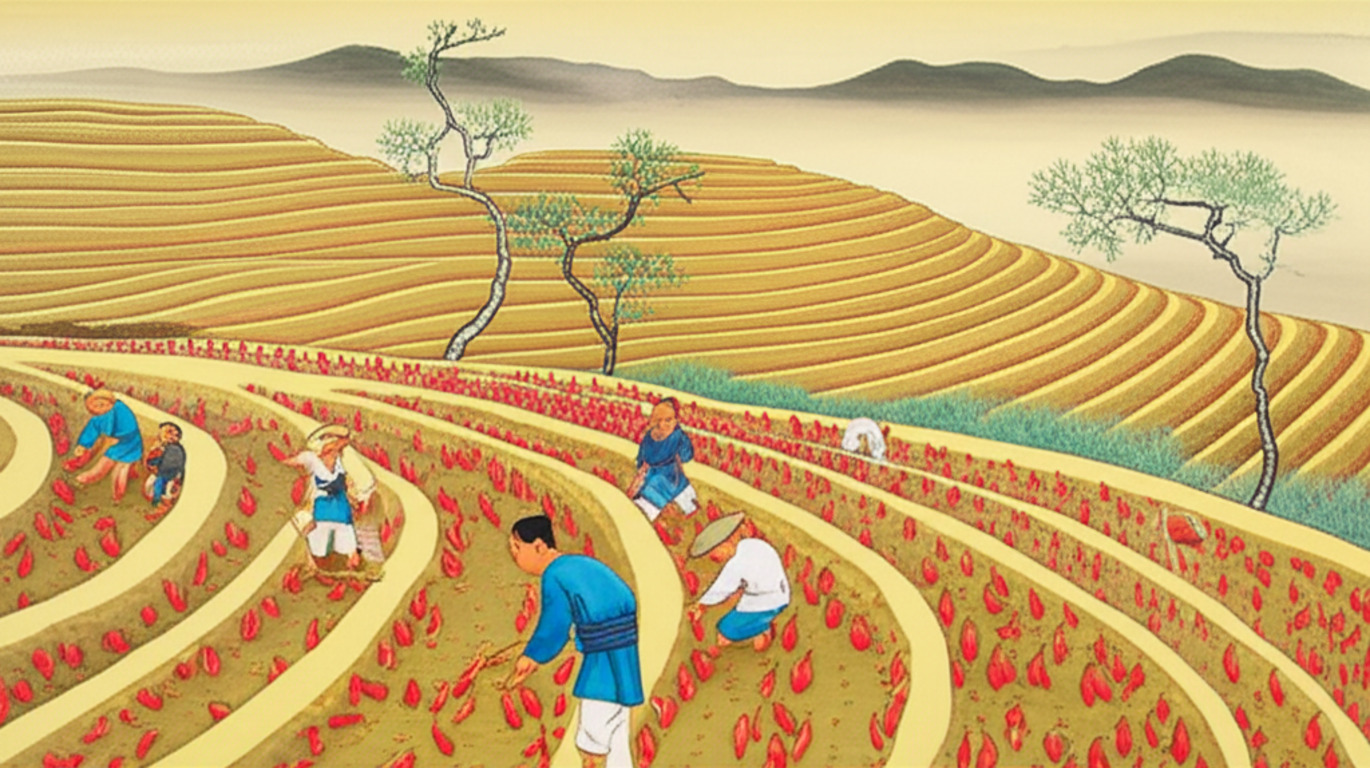
Understanding the Ming's agricultural vulnerability requires understanding its crop geography. China's agricultural landscape was — and remains — divided along the Qinling Mountains-Huai River line, one of the most consequential biogeographical boundaries in world history. North of this line, the climate was too cold and dry for paddy rice cultivation. Farmers in the North China Plain, the loess plateaus of Shaanxi and Shanxi, and the arid corridors of Gansu depended on drought-resistant dry-farmed cereals: millet (su, Setaria italica), wheat (mai, Triticum aestivum), and sorghum (gaoliang, Sorghum bicolor).[3]
South of this line, the monsoon-fed river systems of the Yangtze, Pearl, and Min rivers supported intensive paddy rice cultivation. Rice yields per hectare were substantially higher than those of northern dry-farmed cereals — often two to three times greater — and in the warmer southern regions, double-cropping (two rice harvests per year) or rice-wheat rotation further amplified output. This productivity differential meant that the south generated the grain surpluses that subsidized the north, a pattern of inter-regional transfer that the Grand Canal made physically possible and the state tax system made institutionally mandatory.[4]
The critical vulnerability was this: the northern crops — millet and wheat — were far more sensitive to the kinds of climate perturbations that the Little Ice Age would bring. Millet requires 90 to 120 frost-free days and adequate spring rainfall for germination. Winter wheat, planted in autumn and harvested the following summer, is vulnerable to exceptionally harsh winters that kill the dormant crop. A shortened growing season, a delayed monsoon, an early frost, or a prolonged drought could devastate northern harvests while leaving southern rice production relatively intact. The Ming state's fiscal and military infrastructure, however, was concentrated in the north — the capital, the frontier garrisons, and the postal relay system all depended on northern grain. When the north's harvests failed, the entire imperial system was imperiled.
1.3 The Silver Economy and Population Pressure
By the late sixteenth century, the Ming agricultural system was already under strain from forces that had nothing to do with climate. The global silver trade, unleashed by the Spanish conquest of the Potosi mines in present-day Bolivia and the Japanese development of the Iwami Ginzan mines, flooded China with silver and monetized its economy. In 1581, Grand Secretary Zhang Juzheng implemented the "Single Whip" reform (yitiao bianfa), which consolidated the bewildering array of traditional tax obligations into a single payment in silver.[5]
The reform was administratively elegant but created a new vulnerability: farmers now needed to sell their grain to obtain silver for tax payments. When harvests failed, grain prices soared — but the tax obligation remained fixed in silver terms. Farmers who could not sell grain (because they had none) or who sold at fire-sale prices (because the market was flooded with desperate sellers) found themselves unable to meet their tax obligations. Default led to arrest, confiscation, and flight, further reducing the tax base and deepening the fiscal crisis. The silver system thus amplified the political consequences of agricultural failure in ways the old grain-based tax system would not have.[6]
Simultaneously, population growth had pushed cultivation onto marginal lands — steep hillsides, arid plateaus, and flood-prone lowlands — that were the first to fail when climatic conditions deteriorated. The loess plateau of northern Shaanxi, where Li Zicheng's rebellion would originate, was a textbook example: thin, wind-deposited soil that was highly productive in good years but catastrophically vulnerable to drought. When the rains stopped, the loess turned to dust, crops withered, and the land could not support even a fraction of the population that had settled on it during the preceding decades of relative plenty.[7]
II. A Decade of Devastation: Northern Crop Failures (1628–1644)
2.1 The Chronology of Disaster
The agricultural crisis of the late Ming was not a single event but a cascading sequence of disasters that struck with relentless frequency over nearly two decades. Climate historians have reconstructed the record from dynastic histories, local gazetteers (difangzhi), and proxy data including tree-ring chronologies and ice-core records. The picture that emerges is staggering in its severity.[8]
The trouble began in the Tianqi reign (1621–1627). Shaanxi Province experienced severe drought in 1627, and the pattern intensified dramatically after the Chongzhen Emperor ascended the throne in 1628. The Veritable Records of the Ming (Ming Shilu) chronicle a nearly unbroken sequence of calamities: severe drought across Shaanxi in 1628 and 1629; drought combined with locust plagues in Shaanxi, Shanxi, and Henan in 1630 and 1631; catastrophic drought across the entire North China Plain in 1632 through 1634; a devastating famine in Henan in 1635 in which "nine out of ten households were empty"; continued drought and locusts from 1636 through 1640; and a final, apocalyptic combination of drought, locusts, and epidemic disease from 1640 to 1644.[9]
The scale was extraordinary. In the single year of 1640, drought affected virtually every county in Henan, Shandong, Shaanxi, Shanxi, and Hebei — an area home to approximately 60 to 80 million people. The drought of 1640–1641 is now recognized as one of the most severe meteorological events in the past five centuries of Chinese climate history, comparable in intensity (though not in duration) to the catastrophic drought that caused the North China Famine of 1876–1879.[10]
2.2 What the Crop Failures Looked Like on the Ground
The clinical language of official records conceals unimaginable suffering. Local gazetteers from Shaanxi, Henan, and Shandong preserve eyewitness accounts that give voice to the catastrophe. The Gazetteer of Kaifeng Prefecture records that in 1640, "great drought; wheat failed completely; autumn crops failed; people ate tree bark and grass roots; corpses littered the roads; in many villages not a single household survived." The Gazetteer of Yanan Prefecture notes that in northern Shaanxi, "people ate white clay [guanyin tu, literally 'Guanyin soil']; after eating it their stomachs swelled and they died within days." The Gazetteer of Luoyang County reports that by 1641, "human flesh was sold openly in the markets; parents exchanged children to eat, unwilling to consume their own."[11]
These are not literary embellishments. The practice of consuming guanyin tu — a type of montmorillonite clay that provides a sensation of fullness but has no nutritional value and causes fatal intestinal obstruction — is documented across multiple sources and regions. The exchange of children for consumption, though horrific to modern sensibilities, follows a pattern recorded in every major Chinese famine from the Warring States period onward and represents the final stage of social collapse before mass death and depopulation.[12]
2.3 The Epidemiological Dimension
Crop failure and famine rarely kill alone. Malnutrition weakens immune systems, displacement concentrates populations in unsanitary conditions, and the consumption of contaminated food and water breeds epidemic disease. The late Ming was no exception. Beginning in 1641, a devastating plague swept across northern China, killing hundreds of thousands in Hebei, Shanxi, and Shandong. The disease, which contemporary sources describe as causing swelling of the lymph nodes, fever, and rapid death, is now believed by most historians to have been bubonic plague (Yersinia pestis), possibly transmitted by rodents driven into human settlements by the drought.[13]
Beijing itself was struck in 1643–1644. Cao Shuji's meticulous demographic research estimates that the plague killed approximately 200,000 people in the capital in the months immediately before Li Zicheng's assault — roughly 20 to 25 percent of the city's population. The garrison troops defending Beijing were so weakened by disease and starvation that they offered virtually no resistance when the rebel army arrived. The fall of Beijing was thus not simply a military event; it was the culmination of an epidemiological and nutritional catastrophe that had already hollowed out the city's capacity to defend itself.[14]
III. The Granary System's Collapse
3.1 The Design of the Changping Cang System
The Ming granary system represented one of the most sophisticated food security institutions in the pre-modern world. At its core was the changping cang (ever-normal granary, 常平倉), a concept dating back to the Han Dynasty. The principle was elegant: the state purchased grain at above-market prices during abundant harvests (supporting farmer incomes and preventing price crashes) and sold grain at below-market prices during famines (preventing price gouging and starvation). The system served simultaneously as a price stabilization mechanism, a social safety net, and a strategic reserve.[15]
Under the early Ming, the granary system was extensive. By regulation, every county was required to maintain one or more granaries stocked with reserves sufficient to sustain the local population through a poor harvest. In addition to the ever-normal granaries, the Ming maintained yucang (preparedness granaries, 預備倉) at the county and sub-county levels, as well as shecang (community granaries, 社倉) at the village level. Military garrisons maintained their own reserves. At its peak in the early fifteenth century, the combined system held tens of millions of shi (stone, approximately 100 liters) of grain — enough, in theory, to buffer several consecutive bad harvests across substantial portions of the empire.[16]
3.2 Hollowed from Within: Corruption and Neglect
By the late sixteenth century, however, the granary system had been fatally compromised. The rot was both institutional and fiscal. Local officials, responsible for maintaining granary stocks, discovered that grain reserves were a tempting source of revenue. Stocks were "borrowed" for other purposes, sold on the market during price spikes, or simply embezzled. When central inspectors arrived, officials falsified records, presenting empty granaries as full or substituting rotten grain for fresh. The "Single Whip" reform of 1581, by converting tax payments from grain to silver, further undermined the system: with fewer grain payments flowing into state coffers, it became harder to replenish granary stocks through normal fiscal channels.[17]
The problem was compounded by the late Ming's broader fiscal crisis. Military expenditures consumed an ever-larger share of the budget — the Imjin War against Japan in Korea (1592–1598), the Bozhou Rebellion in the southwest (1589–1600), and the escalating conflict with the Jurchens in Liaodong all drained the treasury. Granary replenishment, being a long-term investment with no immediate political payoff, was repeatedly deferred in favor of more pressing military needs. By the time the great droughts struck in the 1630s, many county granaries in northern China held a fraction of their mandated reserves — or were completely empty.[18]
3.3 The Failure in Action
When the crop failures intensified after 1628, the consequences of granary depletion became immediately apparent. Local officials, tasked with distributing relief grain to starving populations, found their granaries bare. Requests for emergency transfers from other regions were delayed by bureaucratic inertia, transportation bottlenecks on the Grand Canal, and the simple fact that neighboring provinces were often suffering similar crises. The court dispatched relief commissioners (zhenya) to the worst-affected areas, but they arrived with inadequate resources and impossible mandates.[19]
The contrast with the early Ming is instructive. When the Yongle Emperor (r. 1402–1424) faced severe drought in Shandong in 1410, he immediately suspended tax collection in the affected counties, dispatched grain from the capital's reserves, and ordered neighboring provinces to ship emergency supplies. The system worked because the granaries were full, the fiscal position was strong, and the bureaucratic machinery was responsive. Two centuries later, the Chongzhen Emperor faced far worse disasters with empty granaries, a bankrupt treasury, and a bureaucracy paralyzed by factionalism. The institutional capacity for disaster response had atrophied at precisely the moment it was most desperately needed.
The granary failure carried a devastating political consequence beyond the immediate suffering it caused. The implicit social contract of Chinese governance — what the Confucian tradition called the "Mandate of Heaven" (tianming) — rested on the ruler's ability to provide for his people during times of distress. When the state could not feed the starving, the mandate was forfeit. The empty granary was not merely an administrative failure; it was a metaphysical one, a visible sign that Heaven had withdrawn its favor from the ruling house.[20]
IV. The Fiscal-Military Death Spiral
4.1 The Revenue Collapse
The arithmetic of the late Ming fiscal crisis was brutally simple. Crop failures meant that farmers could not pay taxes. Tax arrears accumulated across the northern provinces: by the mid-1630s, Shaanxi was remitting less than 30 percent of its assessed taxes, and Henan was not far behind. Farmers who could not pay fled their land, further eroding the tax base. Those who remained faced the perverse consequence of a fixed-assessment system: as neighbors defaulted and fled, the remaining households were held collectively responsible for the unpaid taxes of the departed, increasing the burden on those least able to bear it.[21]
The revenue numbers tell the story. In the early Wanli reign (1570s–1580s), total state revenue had reached approximately 4 million taels of silver annually from land taxes, supplemented by salt monopoly revenues and miscellaneous levies. By the Chongzhen reign, actual collections had plummeted even as military expenditures soared. The deficit was staggering. To bridge the gap, the court imposed a series of emergency surcharges — the liaoxiang (Liaodong military levy), the jiaoxiang (suppression levy for domestic rebellions), and the lianxiang (training levy) — which together added approximately 20 million taels of new taxation on top of an already crushing burden.[22]
4.2 The Liaodong Dilemma
The fiscal crisis cannot be understood apart from the military crisis on the northeastern frontier. Since Nurhaci's unification of the Jurchen tribes and his declaration of the Later Jin dynasty in 1616, the Ming had been locked in an escalating conflict in Liaodong that consumed enormous resources. The Battle of Sarhu in 1619, in which the Ming suffered a catastrophic defeat, marked the beginning of a defensive war that would drain the treasury for the next quarter-century.[23]
Maintaining the Liaodong defense required approximately 5 to 8 million taels of silver annually — more than the entire regular land tax revenue. The frontier garrisons needed grain, horses, weapons, armor, and most critically, monthly silver stipends for the soldiers. When stipends went unpaid, soldiers deserted, mutinied, or defected. In 1631, the garrison at Wuqiao mutinied over unpaid wages and rampaged through Shandong, causing destruction that further reduced tax revenues from one of the empire's most productive provinces. The mutiny of Kong Youde and Geng Zhongming, who eventually defected to the Qing with crucial artillery expertise, was a direct consequence of the fiscal-military spiral.[24]
4.3 The Impossible Choice
The Chongzhen Emperor thus faced a dilemma with no solution. Reducing military expenditure on the Liaodong frontier would invite Manchu invasion. Reducing relief expenditure would intensify domestic rebellions. Raising taxes would simultaneously accelerate both crises by pushing more farmers off the land, shrinking the tax base, and swelling the ranks of rebel armies. Every policy option led to the same destination: dynastic collapse.
Some historians have argued that the emperor could have negotiated peace with the Manchus, freeing resources for domestic relief and suppression. In fact, preliminary peace feelers were extended through the Ministry of War official Chen Xinjia in 1642. When word leaked, however, the court's hard-line faction denounced the negotiations as treasonous capitulation, and the emperor, fearful of appearing weak, had Chen executed. The tragedy of the late Ming was not merely that its problems were insoluble but that the political culture of the court — its factionalism, its obsession with moral absolutes, its inability to acknowledge painful tradeoffs — prevented even the exploration of imperfect solutions.[25]
The fiscal-military death spiral can be summarized in a single causal chain: climate deterioration led to crop failures, crop failures led to revenue collapse, revenue collapse led to military underfunding, military underfunding led to frontier defeats and internal mutinies, frontier defeats required additional military spending, additional military spending required higher taxes, higher taxes on an already starving population drove more farmers into rebellion, rebellion required yet more military spending, and the cycle accelerated until the system shattered completely. Agricultural crisis was the engine that drove every stage of this self-reinforcing catastrophe.
V. The Postal Relay Collapse and the Birth of Rebellion
5.1 The Yizhan System: The Empire's Nervous System
Among the lesser-known but critically important consequences of the fiscal crisis was the collapse of the Ming postal relay system (yizhan, 驛站). This network of relay stations, spaced at intervals of roughly 30 to 60 li (approximately 15 to 30 kilometers) along the empire's major highways, served as the nervous system of imperial governance. Relay riders carried official dispatches, military intelligence, and administrative correspondence across the vast territory of the empire. Relay stations also provided lodging, food, and fresh horses for officials traveling on government business.[26]
The system employed a substantial workforce. Each relay station required porters, grooms, cooks, and guards, as well as the maintenance of horses, mules, and boats. Estimates suggest that the total number of relay station employees across the empire ranged from several hundred thousand to over a million, depending on the period. These were not well-paid positions, but they provided stable employment and a modest livelihood for men who might otherwise have had few options in the rural economy.[27]
5.2 The Abolition Decision
In 1629, as part of a desperate austerity program, the Chongzhen Emperor accepted a proposal to drastically reduce the postal relay system. The reformer Liu Yixun argued that the system was bloated, inefficient, and rife with corruption — officials abused it for private travel, and many stations were overstaffed. The cuts, implemented swiftly, eliminated an estimated 30,000 to 40,000 positions in a single stroke.[28]
The budgetary savings were real but modest. The political consequences were catastrophic. Tens of thousands of men, many of them in the hardest-hit drought regions of Shaanxi and Gansu, were suddenly thrown out of work at the worst possible moment. With no crops to harvest and no wages to earn, the dismissed relay workers had no means of survival. Many turned to banditry. Others joined the peasant rebel armies that were already forming in the countryside.
5.3 The Case of Li Zicheng
The most consequential of these dismissed relay workers was a young man from Mizhi County in northern Shaanxi named Li Zicheng. Before the cuts, Li had worked as a postal relay worker (yizu) in the town of Yinchuan, earning a meager but steady income. When his position was eliminated in 1629, he found himself unemployed, indebted, and facing arrest for inability to repay a loan. With nothing left to lose, he killed his creditor and joined a rebel band led by his uncle, Gao Yingxiang, beginning a journey that would take him from fugitive bandit to conqueror of Beijing in fifteen years.[29]
The irony is profound. A cost-cutting measure intended to shore up the Ming treasury instead created the man who would destroy the dynasty. The postal relay abolition illustrates a pattern familiar to students of institutional failure: austerity measures that target the institutional infrastructure of governance — the capillaries of the system rather than the arteries — can produce catastrophic unintended consequences that far outweigh the budgetary savings achieved. The Chongzhen Emperor saved a few hundred thousand taels of silver and lost his empire.
Li Zicheng was not unique. Zhang Xianzhong, who would carve out a rival rebel kingdom in Sichuan, was another product of the same crisis. A former soldier from Yan'an in Shaanxi, Zhang had been demobilized in the military cutbacks that accompanied the fiscal squeeze. Like Li Zicheng, he turned to banditry when legitimate employment vanished, and like Li, he harnessed the rage of millions of starving peasants who had been abandoned by a state that could no longer feed or employ them.[30]
VI. North vs. South: A Tale of Two Chinas
6.1 The Differential Impact of Climate Change
One of the most striking features of the late Ming agricultural crisis was its geographical unevenness. While the north suffered catastrophic and repeated crop failures, the south — though not unaffected — experienced significantly less severe disruptions. This differential impact reflected fundamental differences in climate, hydrology, and crop ecology between the two regions and had profound consequences for the political and military dynamics of the dynasty's collapse.
The late Ming cooling, driven by the deepening of the Little Ice Age and possibly amplified by volcanic aerosols from the 1600 eruption of Huaynaputina in Peru, affected northern and southern China through different mechanisms. In the north, the primary impact was on the monsoon: the East Asian summer monsoon weakened, pushing the monsoon rain belt southward and reducing summer rainfall across the North China Plain and the loess plateau. Since northern crops — millet, wheat, and sorghum — were entirely rain-fed (unlike the irrigated rice paddies of the south), reduced rainfall translated directly into reduced yields. Simultaneously, the growing season shortened: spring arrived later, autumn frosts came earlier, and the window for planting and maturing crops narrowed by two to three weeks.[31]
In the south, the impact was more complex. The southward shift of the monsoon rain belt actually increased rainfall in some southern regions, and rice paddy agriculture, with its elaborate irrigation infrastructure, was better buffered against precipitation variability. The longer and warmer growing season in the south meant that even with some cooling, double-cropping remained viable in most areas. While the south did experience localized droughts, floods, and poor harvests, these never approached the sustained, region-wide devastation that characterized the north.[32]
6.2 The Grand Canal Bottleneck
The north-south differential created a logistical crisis centered on the Grand Canal, the 1,800-kilometer artificial waterway that connected Hangzhou in the south to Beijing in the north. Under normal conditions, the canal transported approximately 4 million shi of grain northward annually — the lifeblood of the northern capital and the frontier garrisons. When northern harvests failed, the demand for southern grain intensified, but the canal's capacity was finite and already strained by decades of deferred maintenance.[33]
Moreover, the canal itself was affected by the climate crisis. The northern sections of the canal, particularly the stretch through Shandong, depended on water from the Yellow River and local springs for their water levels. Drought reduced these water sources, making sections of the canal too shallow for the grain barges that carried southern rice northward. In several years during the 1630s, canal traffic was seriously disrupted, cutting off the northern capital from its southern supply lines at precisely the moment when the need was greatest.
6.3 Political Implications of the North-South Divide
The differential impact of the crisis deepened an already existing political fault line between northern and southern elites. Southern landlords and merchants, whose wealth was less directly threatened by the northern droughts, resisted the court's demands for emergency contributions and increased tax assessments. When the Chongzhen Emperor called upon wealthy individuals to donate funds for military defense and famine relief, the response was tepid. The notorious refusal of the Imperial Prince of Fu (Fu Wang) in Henan to open his vast personal treasure stores for disaster relief — even as his own province starved — became a symbol of elite indifference to the crisis.[34]
This north-south divide also shaped the pattern of the dynasty's collapse. When Li Zicheng's armies swept through the north, they encountered populations already devastated by famine and eager to support anyone who promised relief. Li's famous slogan — "Welcome the Dashing King, pay no grain" (ying chuangwang, bu na liang) — was a direct response to the agricultural crisis, promising an end to the crushing tax burden that had compounded the suffering of drought-stricken farmers. The south, by contrast, remained relatively stable and became the base for the Southern Ming resistance after Beijing's fall, sustaining several loyalist regimes that survived for decades after 1644.
VII. From Agricultural Crisis to Dynastic Collapse
7.1 The Rebel Movements as Agricultural Uprisings
The great rebel movements of the late Ming are often characterized as political or military phenomena. But at their root, they were agricultural uprisings — the desperate response of farming communities to conditions that made survival impossible through legitimate means. The geography of rebellion maps almost perfectly onto the geography of crop failure. The earliest risings, in 1628–1630, originated in the drought-ravaged loess plateau of northern Shaanxi. As the drought expanded eastward and southward through the 1630s, the rebellion expanded with it, engulfing Shanxi, Henan, Hubei, and Sichuan in sequence.[35]
The social composition of the rebel armies confirms their agricultural origins. The rank and file were overwhelmingly peasant farmers, supplemented by dismissed postal relay workers, demobilized soldiers, and refugees from famine-stricken areas. They were not ideological revolutionaries but survival migrants, people who had exhausted every alternative before taking up arms. Many rebel bands began as groups of starving villagers who banded together to raid granaries, and only gradually evolved into organized military forces under charismatic leaders.
Li Zicheng's movement is particularly instructive. After years of setbacks, including a near-total defeat in 1638, Li rebuilt his army in the famine-devastated countryside of Henan in 1640–1641. The catastrophic drought of those years delivered millions of desperate, starving people into his ranks. He offered what the Ming state could not: food. His army distributed grain from captured government and landlord stores, earning loyalty that the dynasty had forfeited. By 1643, Li controlled most of Shaanxi and Henan and could field an army estimated at over 600,000 — not because of military genius alone, but because agricultural collapse had made the existing order intolerable for tens of millions of people.[36]
7.2 Zhang Xianzhong and the Sichuan Catastrophe
If Li Zicheng's rebellion was shaped by the crop failures of the northern plains, Zhang Xianzhong's movement revealed how agricultural crisis could interact with other factors to produce catastrophic outcomes even in relatively fertile regions. Zhang's forces invaded Sichuan in 1644, establishing a short-lived kingdom in Chengdu. The Sichuan Basin, sheltered by mountains and blessed with abundant water, had been less severely affected by the northern droughts. But Zhang's conquest introduced a new form of devastation: the disruption of agricultural production by military occupation, forced requisitioning, and mass violence.[37]
The result was a demographic catastrophe. While the extent of Zhang Xianzhong's massacres has been debated by historians — Qing-era sources may have exaggerated his atrocities for political purposes — it is clear that the combination of war, famine, and epidemic disease caused a massive population decline in Sichuan. Some estimates suggest that the province's population fell from approximately 3 million to fewer than 500,000 by the 1660s. The Qing government subsequently organized the large-scale resettlement program known as "Huguang fills Sichuan" (Huguang tian Sichuan) to repopulate the depopulated province, demonstrating the scale of the disaster.[38]
7.3 The Final Collapse
By early 1644, the cumulative weight of agricultural crisis, fiscal collapse, military defeat, epidemic disease, and social disintegration had made the Ming Dynasty's fall inevitable. The army defending Beijing was starving, unpaid, and riddled with plague. The city's population had been halved by disease and flight. The treasury was empty; when the emperor appealed for contributions from the court nobility, they pleaded poverty. On April 24, Li Zicheng's forces breached the outer walls. The next morning, the Chongzhen Emperor, having failed to organize an escape, walked to the back of the Forbidden City and ended his life.
In his suicide note, reportedly written on the lapel of his robe, the emperor wrote: "I have reigned for seventeen years. Though my virtue is slight, the fault lies in the officials who misled me. I have no face to meet my ancestors in the underworld." It was a characteristically Confucian attribution of blame — and a characteristically incomplete diagnosis. The officials had indeed failed him, but the deeper failure was structural and environmental: an agricultural crisis of unprecedented severity had overwhelmed an institutional infrastructure already weakened by decades of neglect and fiscal overextension. No amount of ministerial competence could have compensated for empty granaries and barren fields.
VIII. Lessons for Modern Food Security and Climate Adaptation
8.1 The Granary Lesson: Strategic Reserves Matter
The collapse of the Ming granary system offers a pointed lesson for contemporary food security policy. The changping cang system was well designed in principle — the concept of counter-cyclical grain purchasing and distribution remains the foundation of modern strategic reserve programs — but it failed because of chronic underfunding, corruption, and the diversion of resources to military spending. Today's equivalents face similar risks. National grain reserves are maintained by most major agricultural countries, but their adequacy is rarely tested until a crisis arrives, and the temptation to reduce reserves in favor of more immediate spending priorities is perennial.[39]
China itself has internalized this historical lesson more deeply than perhaps any other nation. The People's Republic maintains the world's largest strategic grain reserves, estimated at over 300 million tonnes — enough to feed the entire country for approximately 14 months. This commitment reflects not abstract policy analysis but a civilizational memory of what happens when the granaries run empty. The late Ming catastrophe is not ancient history in Chinese policy circles; it is a living cautionary tale.[40]
8.2 The Fiscal Lesson: Austerity in Crisis Can Be Fatal
The Ming's response to its fiscal crisis — raising taxes on a starving population and cutting institutional infrastructure like the postal relay system — accelerated rather than arrested the dynasty's decline. The parallel to modern austerity debates is inescapable. When governments respond to fiscal pressure by cutting the social safety net, reducing agricultural support programs, or deferring infrastructure maintenance, they may achieve short-term budgetary savings at the cost of long-term systemic fragility. The Chongzhen Emperor's decision to abolish the postal relay stations saved perhaps 600,000 taels of silver and cost him his dynasty. Modern governments that cut climate adaptation spending, agricultural extension services, or food assistance programs in pursuit of fiscal targets may be making analogous errors.
8.3 The Supply Chain Lesson: Single Points of Failure
The Ming's dependence on the Grand Canal as its primary north-south grain transport route created a single point of failure that the climate crisis ruthlessly exposed. When drought lowered water levels in the canal's northern sections, the entire supply chain failed. Modern food systems face analogous vulnerabilities. The COVID-19 pandemic and the 2021–2022 supply chain crisis demonstrated that just-in-time logistics, concentrated production, and long-distance transport create fragilities that are invisible in normal times and catastrophic in crisis. The Ming example suggests that resilience requires redundancy — multiple transport routes, distributed storage, and diversified supply sources — even when such redundancy appears inefficient under normal conditions.[41]
8.4 The Crop Diversity Lesson
The Ming's vulnerability was amplified by the limited range of crops available for northern agriculture. Millet and wheat, for all their advantages, shared similar vulnerabilities to drought and shortened growing seasons. The introduction of New World crops — sweet potatoes, corn (maize), and peanuts — which would transform Chinese agriculture under the Qing, came too late to save the Ming. Sweet potatoes, which can produce substantial yields on marginal land with minimal rainfall, were first introduced to Fujian Province in the 1590s but had not yet spread to the northern provinces where they were most desperately needed by the 1630s.[42]
The lesson for modern food security is clear: crop diversification is a form of insurance. Agricultural systems that depend heavily on a small number of staple crops are inherently fragile. The current global food system's dependence on just three grains — rice, wheat, and corn — for approximately 60 percent of global caloric intake creates a vulnerability that climate change is already beginning to test. Investment in drought-resistant varieties, heat-tolerant cultivars, and alternative staple crops is not merely a technical exercise in agronomy; it is a strategic imperative for civilizational resilience.[43]
8.5 The Political Lesson: Institutional Flexibility Under Stress
Perhaps the deepest lesson of the late Ming collapse is institutional. The Ming state was not destroyed by crop failures alone; it was destroyed by its inability to adapt its institutions to unprecedented stress. The tax system could not flexibly reduce assessments in disaster-affected areas. The military system could not reallocate resources between the Liaodong frontier and domestic security. The political culture could not tolerate the compromise of peace negotiations with the Manchus. The court could not overcome factionalism to formulate coherent policy. At every level, institutional rigidity transformed a severe agricultural crisis into a terminal political one.
Modern states face the same challenge. Climate change will produce agricultural disruptions of increasing frequency and severity — the IPCC's Sixth Assessment Report projects significant declines in crop yields across many regions by mid-century, with particularly severe impacts in tropical and subtropical zones.[44] The question is not whether agricultural crises will occur but whether political institutions will be flexible enough to respond effectively. The late Ming's example suggests that the critical variable is not the severity of the crisis itself but the adaptive capacity of the institutions that must manage it.
The Chongzhen Emperor was not a bad ruler. He was diligent, frugal, and deeply concerned about his people's suffering. But he inherited an institutional system that had been hollowed out by decades of neglect and that lacked the flexibility to respond to a crisis of unprecedented scale. History's verdict on any government's climate adaptation policy will ultimately depend on the same question: when the crisis arrives, will the granaries be full or empty?
References
- Huang, R. (1974). Taxation and Governmental Finance in Sixteenth-Century Ming China. Cambridge: Cambridge University Press. The foundational study of Ming fiscal institutions.
- Brook, T. (2010). The Troubled Empire: China in the Yuan and Ming Dynasties. Cambridge, MA: Harvard University Press. [DOI]
- Ho, P.-T. (1959). Studies on the Population of China, 1368–1953. Cambridge, MA: Harvard University Press. Includes extensive discussion of crop geography and agricultural zones.
- Perdue, P. C. (1987). Exhausting the Earth: State and Peasant in Hunan, 1500–1850. Cambridge, MA: Harvard University Press. On rice agriculture and the south-north grain transfer system.
- Huang, R. (1981). 1587, A Year of No Significance: The Ming Dynasty in Decline. New Haven: Yale University Press. Includes analysis of the Single Whip reform and its consequences. [Publisher]
- Von Glahn, R. (1996). Fountain of Fortune: Money and Monetary Policy in China, 1000–1700. Berkeley: University of California Press. On the silver economy and its vulnerabilities.
- Marks, R. B. (2012). China: Its Environment and History. Lanham, MD: Rowman & Littlefield. Chapter on the loess plateau and its environmental fragility.
- Zheng, J., et al. (2014). "How climate change impacted the collapse of the Ming Dynasty." Climatic Change, 127, 169–182. [DOI]
- Veritable Records of the Ming (Ming Shilu). Collated edition by the Institute of History and Philology, Academia Sinica. Chongzhen reign disaster records are distributed throughout the volumes covering 1628–1644.
- Zhang, D. (2005). "Severe drought events as revealed in the climate records of China and their temperature situations over the last 1000 years." Acta Meteorologica Sinica, 19(4), 485–491.
- Xia, M. (1961). Chronicle of Disasters and Famines in China Through the Ages (Zhongguo lidai zaihuang). Edited and expanded by Deng Tuo. Beijing: Beijing Publishing House. Primary compilation of local gazetteer disaster records.
- Edgerton-Tarpley, K. (2008). Tears from Iron: Cultural Responses to Famine in Nineteenth-Century China. Berkeley: University of California Press. Discusses the trope and reality of cannibalism during Chinese famines.
- Cao, S. (2001). "Plague in the late Ming: An epidemiological and demographic analysis." Historical Research (Lishi Yanjiu), 2001(1), 17–32. [In Chinese]
- Cao, S. (2004). A History of Chinese Population (Zhongguo renkou shi), Vol. 4: Ming Period. Shanghai: Fudan University Press. [In Chinese]
- Will, P.-E., & Wong, R. B. (1991). Nourish the People: The State Civilian Granary System in China, 1650–1850. Ann Arbor: University of Michigan Center for Chinese Studies. The definitive English-language study of Chinese granary institutions. [DOI]
- Dunstan, H. (1996). Conflicting Counsels to Confuse the Age: A Documentary Study of Political Economy in Qing China, 1644–1840. Ann Arbor: University of Michigan Center for Chinese Studies. Includes retrospective analysis of Ming granary failures.
- Li, L. M. (2007). Fighting Famine in North China: State, Market, and Environmental Decline, 1690s–1990s. Stanford: Stanford University Press. On the long-term trajectory of famine relief institutions.
- Swope, K. M. (2014). The Military Collapse of China's Ming Dynasty, 1618–44. London: Routledge. [DOI]
- Des Forges, R. V. (2003). Cultural Centrality and Political Change in Chinese History: Northeast Henan in the Fall of the Ming. Stanford: Stanford University Press. Detailed local study of famine and rebellion in Henan.
- Bol, P. K. (2008). Neo-Confucianism in History. Cambridge, MA: Harvard University Asia Center. On the political theology of the Mandate of Heaven.
- Huang, R. (1974). Taxation and Governmental Finance in Sixteenth-Century Ming China. Cambridge: Cambridge University Press. On the collective responsibility tax system and its perverse effects.
- Wakeman, F. E., Jr. (1985). The Great Enterprise: The Manchu Reconstruction of Imperial Order in Seventeenth-Century China. 2 vols. Berkeley: University of California Press. Includes detailed fiscal analysis of the late Ming.
- Swope, K. M. (2009). A Dragon's Head and a Serpent's Tail: Ming China and the First Great East Asian War, 1592–1598. Norman: University of Oklahoma Press. On the fiscal drain of the Imjin War.
- Wakeman, F. E., Jr. (1985). The Great Enterprise, Vol. 1, Chapter 5. On the Wuqiao Mutiny and military defections.
- Huang, R. (1981). 1587, A Year of No Significance. Chapter 7. On the political culture of the late Ming court and its inability to compromise.
- Hucker, C. O. (1985). A Dictionary of Official Titles in Imperial China. Stanford: Stanford University Press. Entries on the postal relay system and its administrative structure.
- Tsai, S.-S. H. (2001). Perpetual Happiness: The Ming Emperor Yongle. Seattle: University of Washington Press. On the early Ming postal system at its peak.
- Parsons, J. B. (1970). The Peasant Rebellions of the Late Ming Dynasty. Tucson: University of Arizona Press. The standard English-language study of the late Ming rebellions, including the postal relay connection. [DOI]
- Gu Cheng (1984). History of Late Ming Peasant Wars (Mingmo nongmin zhanzheng shi). Beijing: China Social Sciences Press. [In Chinese] The authoritative Chinese-language study of Li Zicheng's career.
- Des Forges, R. V. (2003). Cultural Centrality and Political Change in Chinese History. On the social origins of rebel leaders and armies.
- Zhang, P., et al. (2008). "A Test of Climate, Sun, and Culture Relationships from an 1810-Year Chinese Cave Record." Science, 322(5903), 940–942. [DOI]
- Ge, Q., et al. (2010). "Temperature Changes over the Past 2000 yr in China and Comparison with the Northern Hemisphere." Climate of the Past, 6, 61–75. [DOI]
- Leonard, J. K. (1996). Controlling from Afar: The Daoguang Emperor's Management of the Grand Canal Crisis, 1824–1826. Ann Arbor: University of Michigan Center for Chinese Studies. On Grand Canal vulnerabilities.
- Wakeman, F. E., Jr. (1985). The Great Enterprise, Vol. 1, Chapter 2. On elite resistance to emergency contributions.
- Tong, J. W. (1991). Disorder under Heaven: Collective Violence in the Ming Dynasty. Stanford: Stanford University Press. [DOI] Statistical analysis of the geography of rebellion.
- Parsons, J. B. (1970). The Peasant Rebellions of the Late Ming Dynasty. Chapters 4–6. On Li Zicheng's rebuilding of his movement in Henan.
- Dai, Y. (2009). Sichuan and the Qing Migration Policy, 1700s–1900s. Cambridge: Cambridge University Press. On the Sichuan demographic catastrophe and recovery.
- Entenmann, R. E. (1982). "Migration and Settlement in Sichuan, 1644–1796." PhD dissertation, Harvard University. The foundational study of post-war Sichuan repopulation.
- FAO (2023). The State of Food Security and Nutrition in the World 2023. Rome: Food and Agriculture Organization of the United Nations. [FAO]
- USDA (2022). "China's Grain Reserves and Food Security." Grain: World Markets and Trade. Washington, DC: United States Department of Agriculture, Foreign Agricultural Service.
- Clapp, J. (2023). Concentration and Crises: Exploring the Deep Roots of Food System Fragility. MIT Press. On modern food supply chain vulnerabilities.
- Ho, P.-T. (1955). "The Introduction of American Food Plants into China." American Anthropologist, 57(2), 191–201. [DOI]
- Ray, D. K., et al. (2019). "Climate change has likely already affected global food production." PLoS ONE, 14(5), e0217148. [DOI]
- IPCC (2022). Climate Change 2022: Impacts, Adaptation and Vulnerability. Contribution of Working Group II to the Sixth Assessment Report. Cambridge: Cambridge University Press. [IPCC]